
#210: World Cup City - Belgium 🇧🇪
Day 44: Belgitude

Welcome to an ongoing Brussels Notes series exploring the 48 participating countries of the 2026 World Cup, without leaving Brussels. Read the explainer, check out the other entries, and then subscribe.
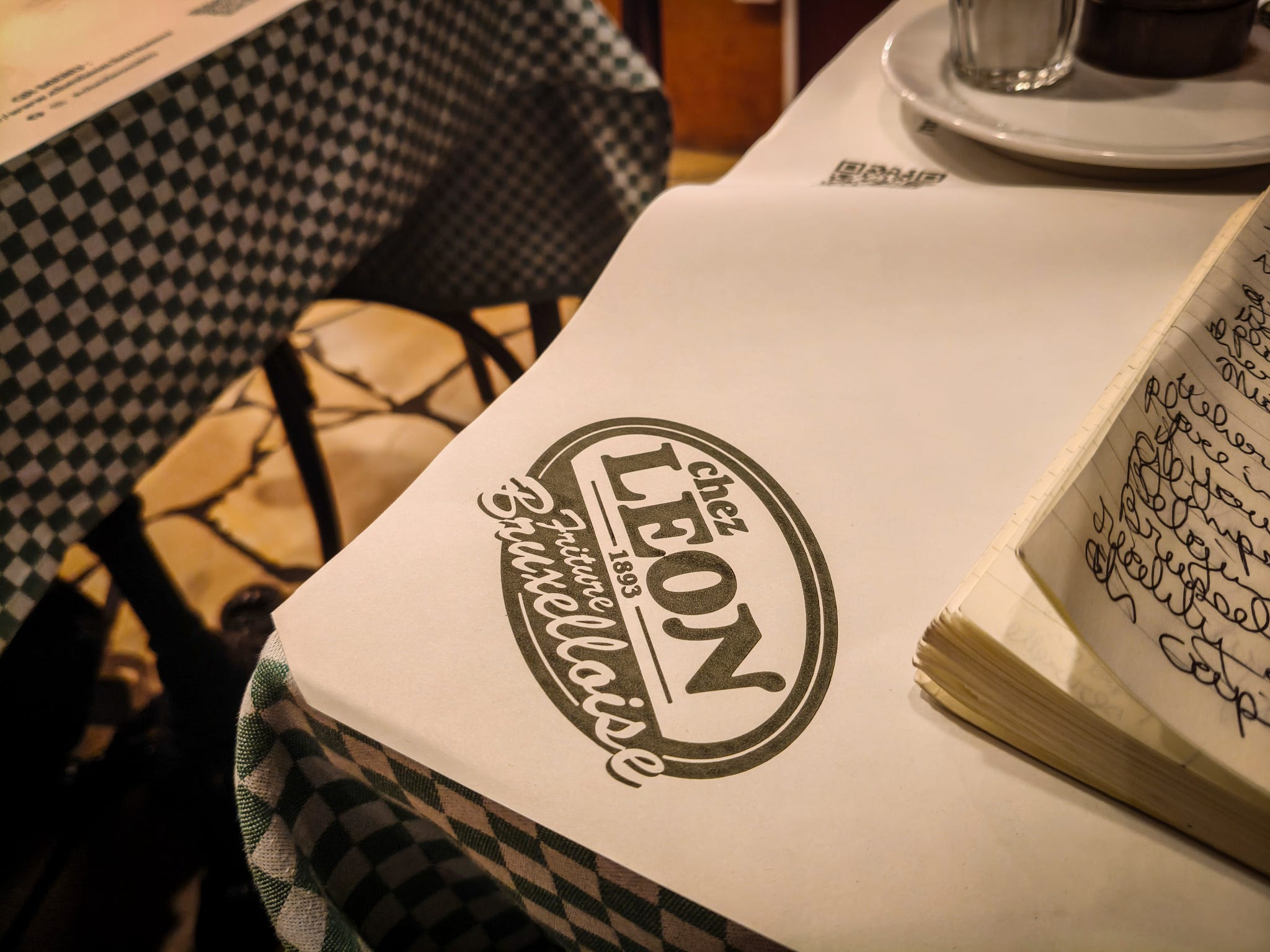
Chez Léon, Rue des Bouchers 18, 1000 Bruxelles
A man - German - and a woman - Hungarian - are sitting at a table for two on the entresol floor of a downtown Brussels restaurant. The man has a goatee and a paunch. The woman could be his colleague or his date. Behind them is a larger-than-lifesize fibreglass statue of a Smurf, arms spread wide and arse hanging out behind his back in bright red trousers. His parents divorced early, and she fell in love with her (younger) therapist back in Budapest. They are talking about heartbreak.
Man: Do you know the song, “Owner of a Lonely Heart”?
Woman: Yes, I think so.
Man: Do you know the chorus, the words? [He starts singing to the tune of the song] “Owner of a lonely heart / Much better than an owner of a broken heart”. This is what I think about love.
Woman: I understand. My problem is, I think, that I go all in, too hard. And then, heartbreak.
A waiter in a green apron arrives with their dessert, and places it on their table between them. Conversation moves on.
***
Ask me what the most Belgian place in Brussels is, and I will struggle. You could point to the various parliaments located in the city, or the statues and sculptures that have reached some level of fame beyond the country’s borders. Maybe one of Brussels’ many museums, the Grand Place, or your own personal idea of what best represents Belgium. For my children, when I asked them, that meant frietjes - more particularly a trip to the frietkot for a cone of fries served with mayonnaise and/or cocktail sauce.
But the more I thought about it, the more I realised I needed to look at the question from another angle. Where would a tourist, someone just off the Eurostar from London or on shore leave from their cruise ship docked up in Zeebrugge, someone with no prior knowledge of the city who’s just flown in from Madrid for the weekend - if you asked them where they might have glimpsed the true Brussels, the authentic Belgium, the corner of the city representative of the country’s rich culinary tradition, what would they say. And then it came to me. I think, if you know Brussels, and you know me, you might already know where I am going with this (the clue was at the top of the article).
If so, say it with me: RUE. DES. BOUCHERS.
It was obvious. Here is a street, a narrow alley that rolls down a steep incline from Gare Centrale before skirting the Grand Place and emptying out behind Boulevard Anspach, charting centuries of Brussels history, architecture and patrimony. A street that might once have been the core of a Brussels nightlife district centred around the Îlot Sacré (the Holy Islet) - frequented by Jacques Brel, Jan Mulder, and the rest of the city’s post-war demi monde - but which has long since been converted into a holding pen, a quarantine zone, for the tourists that visit the city so that the rest of us can get on with our lives unencumbered by their nuisances.
Yes, the restaurants that line the street today - selling moules by the bucket, spare ribs, and overpriced vol au vent - are mostly to be avoided, as are the men that stand at their entrances attempting to hustle unsuspecting tourists through their doors. It is a fat-soaked riot of laminated menus, wobbly wicker tables, and blinking neon, though lately the city has been trying to tart up its image by banning terraces without a permit. And despite its reputation as a sink for outdated and overpriced food, it is still home to two culinary totems of old Brussels: the lead-lined windows of Aux Armes de Bruxelles if your wallet is fat, and across the street the more workaday Chez Léon if times are tougher.
The Léon is an institution. Though it’s recently changed ownership, and has franchises in France and England, the original restaurant still occupies the same spot on Rue des Bouchers where it opened as the Friture Léon in 1893 - though it has since expanded to occupy the whole corner of Rue des Bouchers and Rue des Dominicains. Important too is the fact that I have never been. I have walked past its smoky windows and the red and green neons hanging over its entrance, but I have never gone inside. I never had a reason to; when you live in Brussels, to be seen dining on the Rue des Bouchers would have been a blow to my, to anyone’s, credibility. Until today.
I let a man in chef’s whites guide me through the wooden front door and past the pink elephant hanging in the window and up the wide main stairway to a mezzanine level at the back of the restaurant. I am seated by one of his colleagues on a table for two right in the corner; I choose to sit on the grey leather banquette that stretches the length of the mezzanine, above which is wooden panelling studded with brass name plates (my seat says “Michel Boujenah”, which the internet tells me is a Franco-Tunisian comedian). The seat affords me a partial view of the main dining room below, the tables of which are beginning to fill up with tourists - like me - escaping the midday heat. It is not much cooler inside Chez Léon, where the muggy air is thick with the smell of chip fat and the waiters running around the place in their green aprons and longsleeved white shirts are all glistening.
Chez Léon seems to be made entirely of staircases, nooks, crannies, and alcoves. In the century since it opened as a humble friterie the restaurant has metastasised to occupy nine buildings in a labyrinthine confusion. Behind the mezzanine level where I am sitting there is a large round room largely hidden from view but into which a steady stream of Hispanic tourists and their baby buggies keep disappearing. To get to the upstairs toilets, you have to go down a level, then up another level, climb a set of stairs, take several turns up left and right and up another small flight of steps. In one upper floor stairwell there is a display of cascading Belgian comic books arranged as if they are bursting out of a wooden treasure chest.
The menu is part-museum flyer, part-surf and turf speedrun through the Belgian classics. There are fish platters, croquettes (cheese and grey shrimp), Spaghetti Bolo, casseroles of moules in various sauces and flavours, stoemp, filet américain préparé, waterzooi, chicon gratin, and stoofvlees. It does not strike me as the type of place that would accept a diner ordering a starter as a main, or a side as a starter. As for the salads, the vegetables take a back seat to the fried mussels, lardons and chicken. But I didn’t come here to order a salad, and nor did any of the Asian and American tourists beginning to populate the tables on the ground floor. So I flip to the back of the menu and when my sweaty waiter returns to take my order I ask for what feels like the least meaty option: the stoemp du jour, with a glass of La Léon blond beer. It’s only when he returns a dozen or so minutes later with my piping hot plate of stoemp I realise my mistake.
On top of the crude potato-and-vegetable mash are two slabs of thick bacon and a large juicy sausage, into which someone has stuck a toothpick with a small Belgian flag. There’s nothing for it but to dig in, and I’m immediately reminded just how delicious meat is. After a decade of eating meat substitutes, your brain does a good job of convincing you that they are a fair approximation of the real thing; intimate proximity to actual meat will disabuse you of this notion in a mouthful or two. Smoky, fatty, rich, unctuous, and uncomplicated - a perfect accompaniment to the creamy mash underneath, and literally the meat and potatoes of Belgium’s culinary tradition. I had to shake myself out of my fleshy reverie and leave some on the plate so as not to overwhelm my out-of-shape colon with so much animal protein.
But I had eaten well, and I had eaten Belgian, of that there could be no doubt.
***
A man - German - and a woman - Hungarian - are sitting at a table for two on the entresol floor of a downtown Brussels restaurant. The man has a goatee and a paunch. The woman could be his colleague or his date. Their plates are empty and the bill has been asked for. Conversation is ebbing.
Man: To have me is not a good thing. You do not have to be my friend, but to have me as an enemy - that is not good.
Woman: [nods]
Behind, on the main wall of the restaurant, is a large mural. It features, in no particular order: a dragon, an erupting volcano, a cowboy riding a hamburger, a sexy frite, an anthropomorphised mussel shell digging a shallow grave, a Grecian temple.
The waiter comes with the bill. The man pays. The pair thank him, stand up and leave together.
Tomorrow, we’re off to the final four…
Thanks for reading - I’m writer Eoghan Walsh and this is my weekly free-to-subscribe newsletter about life in Brussels. If you like it and you’re not already subscribed, you can sign up here!