
#196: World Cup City - Germany 🇩🇪
Day 30: : War and Pils

Welcome to an ongoing Brussels Notes series exploring the 48 participating countries of the 2026 World Cup, without leaving Brussels. Read the explainer, check out the other entries, and then subscribe.
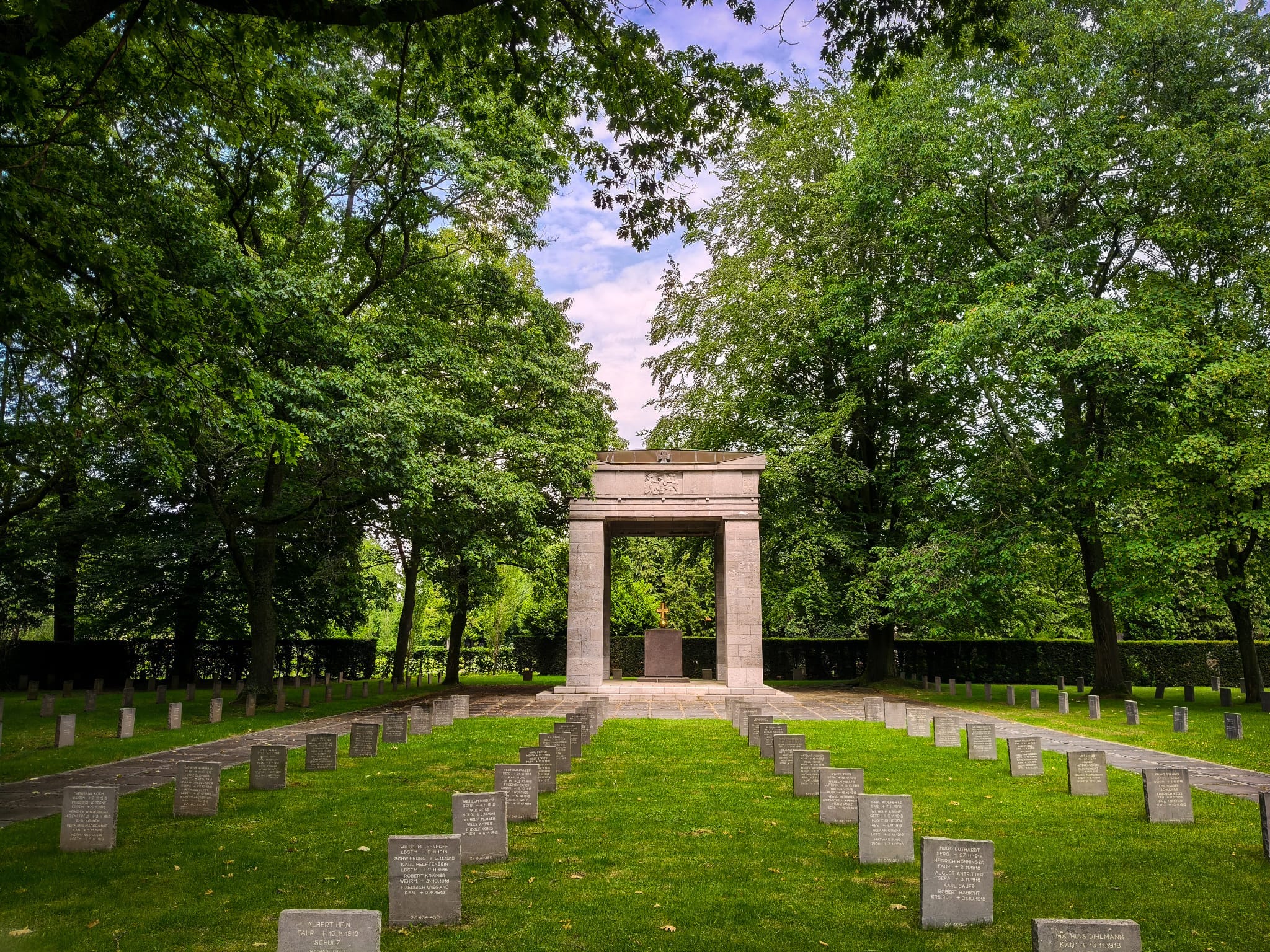
German War Graves, Cimetière de Bruxelles, 1140 Evere / Brasserie de la Mule, Rue Rubens 95, 1030 Schaerbeek
In Brussels’ municipal cemetery, at first glance one war memorial looks much like another. There is one, for example, towards the centre of the graveyard, that has rows of sober slate grey headstones in neat rows fanning out from an imposing central altar built of a sombre, muted rock. The headstones are undecorated save for the name - or names - of the men whose deaths they have been planted as a memorial, and occasionally their rank or position in the army.
Only, this corner of the cemetery is not quite like the one next door, the one planted with blossoming poppies, where the grass looks freshly mown and the brilliantly white gravestones are ornately decorated with the regimental crest, the soldier’s rank, where they were when they were killed, and below all this a large cross carved into the soft beige rock. At the base is an epitaph: “beloved and well remembered always”. This tidy, well-kept site is the cemetery of the victorious commonwealth, and the sombre, unkempt graveyard with its slate grey headstones and monolithic altar serves to remember the German dead, the soldiers of the invader, the occupier and the vanquished of World War I.
Germany occupied Brussels for almost the entire duration of the war, its imperial troops only departing the city after their garrison mutinied on 9 November 1918. They are not fondly remembered (nor are their successors who returned to occupy the city a second time 22 years later). In that context, it is perhaps understandable that their war grave is less well tended than that of Belgium’s liberators. They have also been accorded less space than the Allied troops next door; many of the German gravestones have multiple names carved into them, some representing as many as five dead soldiers. Underneath a large iron cross, in the centre of the tall altar, is a raised plinth onto which has been carved a passage from the Bible in German, Jeremiah 29, verse 11: “For I know the thoughts that I think toward you, saith the LORD, thoughts of peace, and not of evil, to give you an expected end.” On the plinth is a bronze cross-and-orb. It is draped in cobwebs.
It is a quiet, half-wild place, the Brussels cemetery. Beyond the war memorials, many of the laneways are overgrown and the graves flanking them untidy and abandoned. There are few people around on the Saturday morning I visit, none really save for the municipal workers at the ceremonial entrance gate. There is not much life outside its gates either, right on the edge of the city where Brussels dissolves imperceptibly into Flanders. It’s a dour, somnolent atmosphere, and I decide I need a restorative beer, and so I cycle back towards town, submerging myself into the loud, chaotic, and not at all reflective Schaarbeek.
Brasserie de la Mule is, by bike, barely 15 minutes from the cemetery entrance. Since the Maxburg restaurant burned down in 2018, Germany has lacked a culinary outpost in Europe’s capital, save for the annual erection of Oktoberfest tents in Parc Cinquantenaire every Autumn. But Brasserie de la Mule, since opening in the old tram stables a stone’s throw from Place Colignon in 2021, has been doing its best to evangelise for the Teutonic world’s greatest gift to the rest of us: lager beer.
Owner/brewer Joel Galy (who is not German), fell in love with Bavarian bottom-fermented beer and has spent the best part of five years trying to convince his fellow Brussels drinkers of its merits, one Helles at a time. It should not be a difficult challenge; despite its reputation and the home of some of the world’s most complex and characterful beers, Belgium’s dirty little secret is that, really, at heart it is a Pils-drinking country. It just happens to be that most of that Pils is a pale, industrially-produced imitation of the real thing. And at La Mule, they make the real thing.
The brewery’s tap room menu offers the full spectrum of the German brewing tradition: pale and moreish Lagers and Helles; chewy, fruity Weizen; tart Berliner Weisse; austere, pintable Kolsches. There’s usually a Dunkel or Schwarzbier lurking among that lot too, if you’re lucky. And if you’re feeling brave, and have enough shrapnel in your back pocket, you can order a one litre Maßkrug of beer, take it outside to the small terrace and drink yourself to contentment. It’s too early for that today, and I still need my wits about me to navigate home through Schaarbeek on the bike, so I restrict myself to a half-litre of golden-bronze Helles in a cold fluted glass, and think on Brussels’ two great German inheritances.
Tomorrow, we’re sticking around another fallen Northern European giant...
Thanks for reading - I’m writer Eoghan Walsh and this is my weekly free-to-subscribe newsletter about life in Brussels. If you like it and you’re not already subscribed, you can sign up here!
Our local brewery! And I had no idea it was a temple to German beer culture. Another fascinating read, thank you ...