
#191: World Cup City - Tunisia 🇹🇳
Day 25: HOT STUFF

Welcome to an ongoing Brussels Notes series exploring the 48 participating countries of the 2026 World Cup, without leaving Brussels. Read the explainer, check out the other entries, and then subscribe.
TUNISIA v The Netherlands
Rue des Deux Églises 68, 1210 Bruxelles
“Qua piquant, would you like it medium, gentle or spicy?”
Zina is a fast casual take on Tunisian food (or so I gleaned from their Instagram account) is about halfway down the Rue des Deux Églises, which starts in dense, working class Sint-Joost and terminates in the depopulated office town of the European Quarter. Coming downhill from Rue de La Loi you can spot the restaurant’s bright red terrace chairs from several doors down, and the same colour palette continues inside, with ZINA painted on big bold lettering on the windows and a large red menu taking up one wall.
The Brick Tunisienne looked appealing just from the name alone, but rather than something the shape and girth of a literal brick stuffed with whatever Maghrébin specialities they eat in Tunisia it was instead a more mundane samosa-like pastry triangle. Worse, it was stuffed with tuna. In fact, tuna appeared to be Tunisia’s national dish, such was its overbearing presence on Zina’s menu - in the fricasse, the mlawi, the shan tounsi, and in the casse-croûte thon (obviously). I did wonder for a minute whether zina meant tuna in Arabic (it does not; the internet tells me it actually means fornication. Is that right, Arabic-speakers?).
Accepting the absence of an advertised vegetarian alternative (and not even thinking to ask if they provide one) I order a mlawi poulet, and it arrives on a red plastic tray with a side portion of “fries”, which in reality are more like thin slices of potato, fried and suited with seasoning. Alongside the chicken are a variety of ingredients both familiar (olives, cheese, caramelised onions) and of the variety that force me to get out my phone and google them. Malawi is the soft, slightly flakey flatbread into which everything is stuffed; there is also mechouia (a Tunisian salad, houriya (something to do with carrots), and harissa.
“How spicy is spicy? Maybe a medium?”
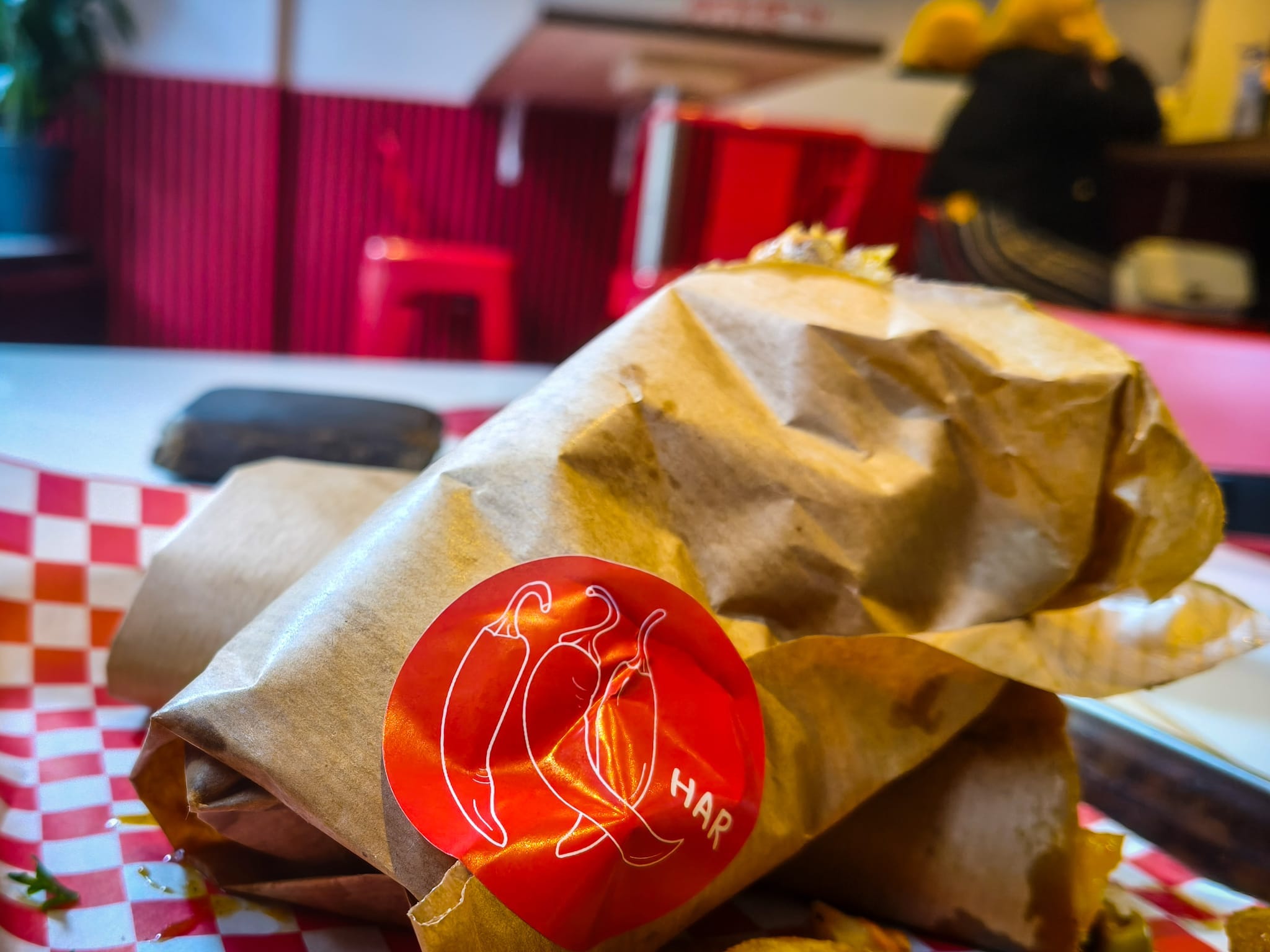
I’d never thought really where harissa came from; it’s not a subject that would have arisen much on our suburban Irish housing estate while growing up in the 1990s. I had always just thought it was, like ras el hanout, a vaguely North African condiment the precise origin of which had been lost in time. It did not take long for Zina to disabuse me of this ignorance. My malawi came wrapped in paper that was sealed with a red sticker featuring illustrations of three chilis and the word “HAR”. On the wall beside my table they had painted a slogan in big red lettering which read “It’s getting Haarrrr.” And on the table itself was a napkin holder made out of a repurposed yellow tin of “Le Phare du Cap Bon” harissa with its iconic lighthouse and bushel of Baklouti peppers logo, and on the side of the label were the words “Produit de Tunisie”.
The mlawi was filling, so much so that I asked the woman behind the counter if I could pack half of it to take with me. Olive tangy, fragrant with the herbs from the mechouia, sweet and anise-y from the spiced carrots, and gummy melted cheese, I’d almost forgotten how good actual, real chicken can taste. And yes, it was spicy. But with a tingle rather than a burn, a heat that was easily washed away by a couple of slugs from my can of lime-flavoured Boga.
Spicy? I could have taken it.
Tomorrow, we’re sticking around the Muslim world...
Thanks for reading - I’m writer Eoghan Walsh and this is my weekly free-to-subscribe newsletter about life in Brussels. If you like it and you’re not already subscribed, you can sign up here!
When I lived in Tunisia we used to joke that the country’s name derived from its excessive use of tuna on everything