
#176: World Cup City - Japan 🇯🇵
Day 9: Orientalism, then and now

Welcome to an ongoing Brussels Notes series exploring the 48 participating countries of the 2026 World Cup, without leaving Brussels. Read the explainer, and then subscribe.
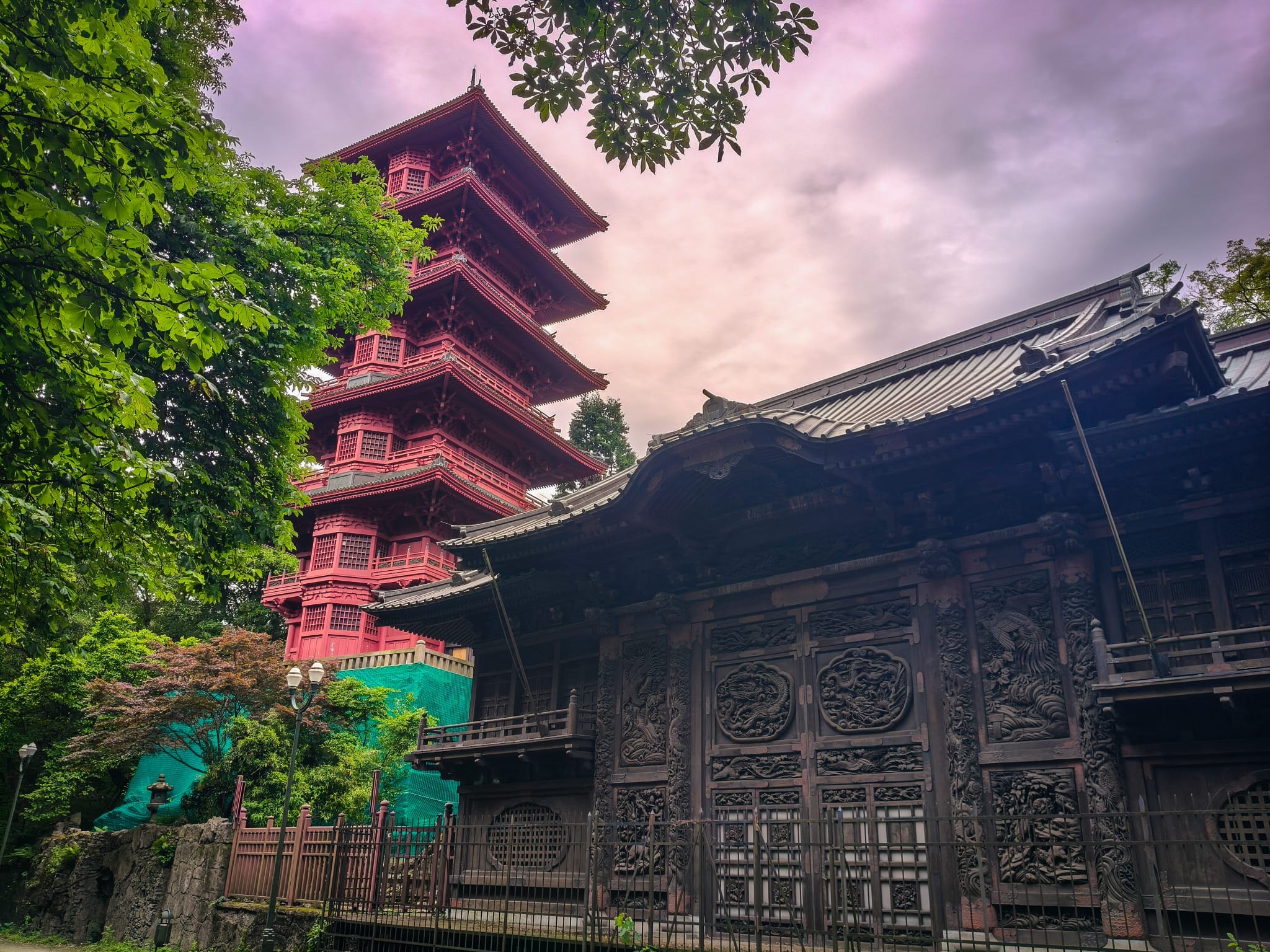
Japanese Tower, Av. Van Praet 44, 1020 Bruxelles/Kage - Specialty Tea Bar, Rue Antoine Dansaert 19, 1000 Bruxelles
Like many of Brussels’ more bombastic imperial follies, Laken’s Japanese Tower and neighbouring Chinese Pavilion were not inspired by a royal visit to the Far East, but by a trip Leopold II took to Paris to visit one the many turn-of-the-19th-century world expositions that city hosted. Just as the king was prompted by the Sacre Coeur in Montmarte to build his own basilica-cum-mausoleum, having seen a reproduction of a Japanese tower at the Expo in 1900, Leopold convinced that building’s architect - a Frenchman - to come to Brussels and build him one of his own on the royal estate at Heysel.
By 1904 Leopold had his Japanese tower in his very own Japanese garden. Though he had to give it up four years later (along with his personal control over the Congo), and though like many of his other architectural adventures the complex of buildings began their inexorable slide into decrepitude in the years after his death, the tower still stands where he commissioned it, looming up unexpectedly out of dense tree cover on the bend of a hyperactive urban highway that cuts through the royal demesne.
For all its inauthenticity, and for all that the years have been unkind to it, the complex (the tower and adjoining pavilion) remains an astounding example of the craftsmanship of those who worked on it. The facade of the lower building, the entrance pavilion, is covered in ornate dark wooden panels, onto which the artisans have carved phoenixes, dragons, sea serpents, lizards, dense forests, and other traditional Japanese iconography. It has a traditional swooping, “hip-and-gable” roof, and is hemmed in by red wooden fences that nod - deliberately or otherwise, to Torii gates.
The wooden facade is dour, and it is hard to tell whether that has always been the case or it has been stained by decades of bad weather, neglect and car exhaust fumes. Bronzed edges and the occasional dash of red that emerges from underneath the accumulated grime suggests underneath the dark stain suggests perhaps not.
The tower alongside it is more impressive again, a cuboid layer cake of the same swooping saddle roofs six stories and 52 metres tall on a raised pedestal above the adjacent garden. It is red, a durable shock of red against the verdure of the private royal park that surrounds it. If you can block out the incessant roar of traffic - the Japanese would surely never allow a highway to be built so close to the kind of temple these buildings are trying to ape - and if you time your visit for the blossoming of the cherry trees that line the road, you could almost imagine yourself in Edo-era Japan.
Here and there at the base of the tower, small strips of red paint have flaked off the central core exposing the grey woodwork underneath, and the pedestal on which it sits is wrapped in a green mesh tarpaulin. The pavilion building is also enclosed by chained-up fences; the whole complex has been shuttered for 15 years because of building safety fears and the impact of years of general neglect on the respective structures. I visited it not long before the authorities closed the site, and on the SD card of an old Sony point-and-shoot I still have some photos of the interior - dark lacquered wood, stained glass windows, imitation Holusai. It was easy for the building to seduce you - that it has survived at all is testament to the quality of its construction over a century ago, but it was very obviously a fabrication, a museum piece that was barely holding itself together.
They do not make anything like this anymore; our engagement with the Orient might not be any more authentic now than it was in Leopold’s time, but it has at least shifted from passive observation to something more participative.
***
Everyone at Kage appears to know exactly what they’re doing. Everyone, except me.
I have never had a Latte before, nor have I ever drunk Matcha tea. I know of the existence of both these drinks, I’m not a recluse. I have heard of their combined drink too, and I am not trying to assert this ignorance as something to be proud of; I am sincerely and unironically ignorant of the whole idea of Matcha, despite the green liquid’s visibility on my Instagram feed. In my defence, I don’t drink coffee, and I don’t drink tea. But however alien the subculture is, I do know that Matcha is a Japanese phenomenon, and that the Kage Speciality Tea Bar is its latest outreach centre in central Brussels.
When I get to the counter to order, the woman at the payment terminal asks if it’s for drink-in or take-out. We both look around the full bar, with every table occupied, and the rain beginning to come down outside, and agree it’s to go.
She asks me what I want and I read a menu that’s full of words and characters I don’t recognise. A Matcha Latte, I answer. Which Matcha, she asks. I read out the name of the first one on the list, called Ying and described as “grassy, chestnut, rich” (when I google this later it will turn out that this particular Matcha is not Japanese at all but from Zhejiang in China). Hot or cold? Cold, please. With oat milk, I add hurriedly.
After I’ve placed my order I see, set into the bar counter under a glass cover, the pastry display. There’s the usual browns and burnt caramels but also pea green pastries and what a little tag says is a Matcha Tiramisu. Another of the bar staff, a man in a minimalist uniform, is responsible for the bringing together of my order. He makes the ritual look rote, but it’s all new to me. He places a metal bowl with a little spout onto a small weighing scales and measures out into the bowl dainty spoonfuls of dense green powder.
He adds a little milk, agitates the mixture with what looks like a shaving brush, only instead of bristly hairs it has flexible copper spines. Then he swirls the whole mixture together. There is a lot of swirling going on here, behind the counter and at the tables. Out on the terrace a woman sitting at a green table on a green patio chair swirls the remnants of her viscous cup of green liquid.
When the man in charge of my drink is happy with the consistency of the mixture in his little metal bowl, he pours it into a plastic cup that’s already been filled with ice and a brown liquid that’s presumably more oat milk? It could be coffee? But surely coffee doesn’t also go into a Matcha Latte? But isn’t Latte a coffee-based drink? I am in unfamiliar territory.
The green mixture first settles on the top, before slowly trickling under the ice and forming great big green sworls. I slap a lid on it and poke a black straw through the cruciform hole in its middle. Walking to the door I see a table had come free, but I’ve committed to my takeaway now and can’t back out.
I make it halfway down the Dansaertstraat and four sups in before I have to stop. People really do drink this stuff? It certainly was grassy, I’ll give the tasting notes that. Grassy and seaweedy, cloying and not for me. I find the nearest bin. Maybe I should have gone for the Matcha tiramisu. Maybe I should stick to pastiche imperial architecture.
Tomorrow, we’re off to Latin America…
Thanks for reading - I’m writer Eoghan Walsh and this is my weekly free-to-subscribe newsletter about life in Brussels. If you like it and you’re not already subscribed, you can sign up here!