
#160: Amnesiac City II
Who deserves to be remembered?

Thanks for reading - I’m writer Eoghan Walsh and this is my weekly free-to-subscribe newsletter about life in Brussels. If you like it and you’re not already subscribed, you can sign up here!
This week’s newsletter makes a pitch for immortality
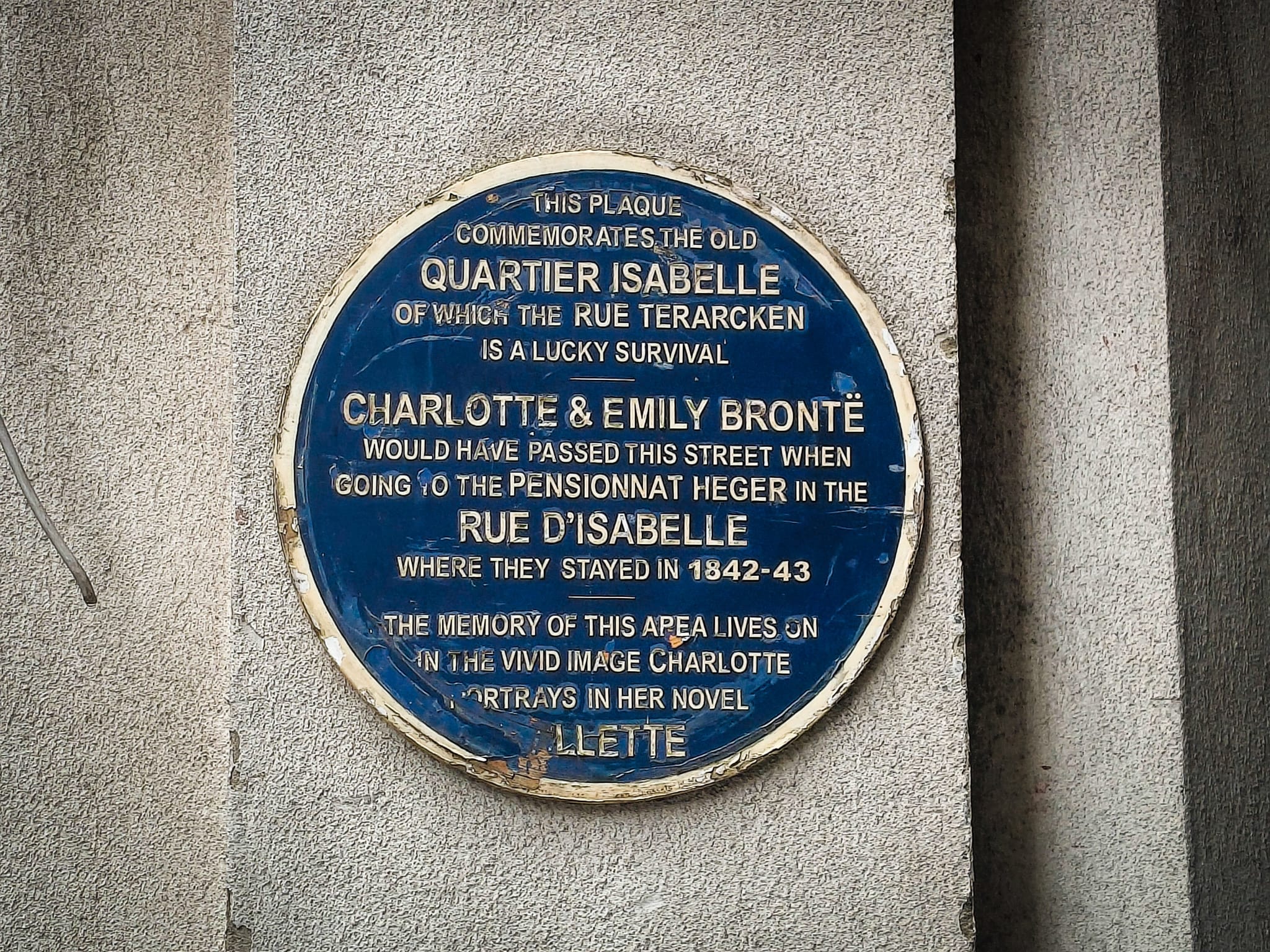
Last week’s newsletter was one long complaint about Brussels’ failure to adequately - or at the very least coherently - commemorate residents that have contributed to the city’s history and development, ultimately concluding that Brussels’ illustrious citizens deserve a blue plaque system of the kind Dublin, London and other cities have had for decades.
This week, knowing that some of you readers chafe against my negativity, I want to be more constructive. If I am arguing for a Brussels blue plaque system to honor past residents and important events in the city’s history, then who or what should receive one? As noted last week, many of Brussels’ most famous (male) residents already have their plaque or memorial at the site of their former residence, or the location to which they are most associated (c.f. The Maison du Cygne on the Grand Place, where Marx and Engels wrote much of The Communist Manifesto).
Instead, I want to shine a light on some of the more egregious oversights, and lesser-known or -celebrated stories of the city, equally deserving of commemorating alongside our war heroes and the literary exiles that have passed through Brussels.
But the suggestions below are mine, and I am opening the comments for you to make your own submissions - who or what do you think deserves a memorial?
Monique Vanderstraeten-Wayez - Rue d’Alsace-Lorraine 33, 1050 Ixelles
The original Maison Africaine on Rue Traversière 13 in St-Josse already has a plaque marking the first location of the organisation established by Monique Vanderstraeten-Wayez in 1960 to house Congolese students studying in Brussels. But in 1969 the organisation opened a larger centre on the Rue d’Alsace-Lorraine, and the Maisaf (as it is known) would become the kernel of an emerging Congolese (and later Central African) community that grew up in the 1970s and 1980s around the Chaussée d’Ixelles - better known today as Matongé.
Chantal Akerman - 23 quai du Commerce, 1000 Bruxelles
The most famous address in Belgian cinema history? Technically, Chantal Akermans’ film is titled Jeanne Dielman, 23, quai du Commerce, 1080 Bruxelles, but the actual address of its titular character is in 1000 Brussels, rather than 1080 Molenbeek. Sight and Sound magazine awarded the meditative (some might say ponderous) Jeanne Dieleman the title of “greatest film of all time” in 2022, and how many other addresses in Brussels can lay claim to such an august title. Surely deserving of some kind of commemoration.
Vincent Van Gogh - 72 Boulevard du Midi, 1000 Bruxelles
72 Boulevard du Midi no longer exists, or no longer exists in the same form that its most famous resident would have known it when he moved into a room upstairs of the café “Aux amis de Charleroi” in October 1880. The building where a young van Gogh set himself to improving his painting while enrolled in the nearby academy of fine arts on Rue du Midi, was demolished in the 20th century and replaced by the expansive railway bridge that spans the wide boulevard today. Vincent didn’t last long on Boulevard du Midi, quitting school in December the same year and eventually ending his Brussels adventure in Spring 1881.
Servanda Tejón Suárez - Rue du Nancy/Rue du Miroir 25, 1000 Bruxelles
Tejón Suárez and her husband, the blind violinist Benjamín Rodríguez (better known as El Ciego) were immigrants from Asturias, who from 1926 ran an underground railroad for escaping Spanish exiles who had slipped out of the country to avoid Francoist repression and made their way to Brussels. Alongside offering cheap accommodation to their compatriots, the pair ran a café on the corner of Rue du Miroir and offered help “regularising their papers, finding work or hiring smugglers to cross the Franco-Belgian border.” The Rue du Nancy, Rue Blaes and Rue Haute eventually became - particularly after a migration deal was signed between the Spanish and Belgian governments in the 1950s - the centre of Brussels’ Hispanic community, traces of which are still evident today (Spanish-language Sunday mass on Place du Jeu de Balle, the Asturian Cabraliego on Rue Haute). Even Julio Iglesias once performed at what is now the Fuse nightclub on Rue Blaes!
Théâtre l’Olympia - Rue August Orts, 1000 Bruxelles
On March 18, 1910, theatregoers filed into the Théâtre de l’Olympia’s auditorium for the premiere of a new play. The proscenium curtain lifted to reveal a man and woman, both young, sitting in an office. A sign hanging behind them said Beulemans, seul dépositaire du stout Glascow [sic] (“Beulemans, sole proprietor of Glasgow Stout”). The woman is Suzanne, the proprietor’s daughter. She is discussing an order for Beulemans’ Petit Bavière with Albert Delpierre, a Frenchman in Brussels to learn the beer trade but struggling to adapt, unable to curl his Parisian tongue around Brussels’ dialect. Albert is also madly in love with Suzanne. Who is, unfortunately, engaged to Seraphin Meulemeester, a member of Brussels’ society of brewers. Suzanne’s father, Ferdinand Beulemans, covets the society’s honorary president position.
Beulemans père enters the scene, to complain about Albert botching a delivery of 100 bottles of stout, exclaiming, “I’m the only supplier of ‘Stout Glascow’....You can’t mess that up!” And so begins Le Mariage de Mlle Beulemans (“The Marriage of Ms. Beulemans”). Beulemans was an immediate success. It ran uninterrupted until May, ending 1910 with over 300 performances across Brussels and Paris. Local audiences in particular took corpulent, vain Beulemans to their hearts because, a contemporary review said, he remained an earthy Bruxellois even as he became a successful brewer, and Brussels’ theatregoers appreciated the “faithful mirror” it held up to the language and mannerisms of the city’s residents.
The theatre was demolished in the 1920s, rebuilt in the 1930s, and eventually subsumed into the Marriott hotel that faces the Beurs building in central Brussels.
Andreas Vesalius - Rue Joseph Dupont, 1000 Bruxelles
You can’t exactly say that the “father of modern human anatomy” hasn’t left his mark on the city of his birth, there being a private college named after him. The medieval street on which Vesalius - imperial physician to Emperor Charles V and author of De Humani Corporis Fabrica Libri Septem (“On the fabric of the human body in seven books”), which revolutionised the study of the human body - was born in 1514 has long since disappeared under the foundations of Brussels’ synagogue, but that doesn’t mean we can’t put up a plaque to mark the spot on the side of that building.
Chantal Akerman at 23, quai du Commerce, for sure! The various places where the Toone theater takes its roots should also be noted
Thank you for educating me on some of the history of Brussels!